EV NEWS EV News
Could Higher Petrol Prices Make an EV Cheaper to Own in India? Work Through the Numbers
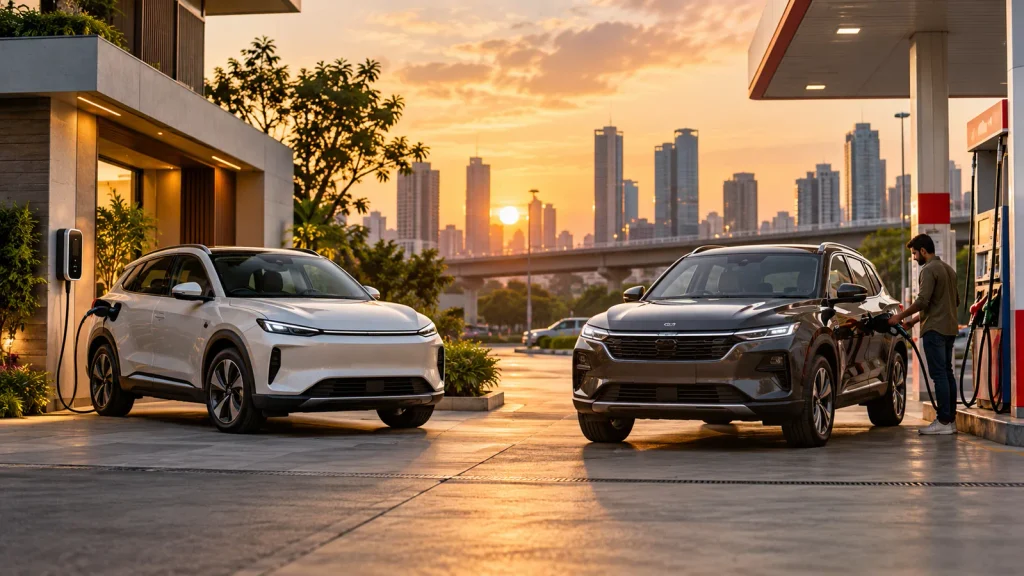
If petrol prices rise, does an electric car automatically become the cheaper choice? It is an appealing headline, but a buyer needs a more useful answer. A Reuters analysis published on 21 September 2026 argued that higher fuel prices can strengthen interest in EVs while increased EV demand can also put pressure on battery-metal supply chains. That is a global market analysis, not a personalised savings estimate for an Indian household. For your own decision, the numbers start with how far you drive and how you charge.
The two costs you can calculate first
For a petrol car, estimated monthly fuel cost is:
Monthly kilometres ÷ real-world km per litre × local petrol price per litre.
For an EV, estimated monthly electricity cost is:
Monthly kilometres × real-world kWh per km × effective electricity price per kWh.
The second price needs care. Home charging may use your domestic tariff, while a public charging network can charge a higher rate and may add service, parking or other fees. Charging losses also mean energy drawn from the wall may exceed energy delivered to the battery. A simple estimate should account for the electricity you pay for, not just the battery capacity printed on a brochure.
Here is an illustrative example, not a quoted Indian tariff or model performance figure. Suppose a household drives 1,200 km a month. Its petrol car returns 15 km/l in its own driving, and the owner enters ₹105/litre as the local petrol price. Fuel cost would be 1,200 ÷ 15 × 105 = ₹8,400 a month.
Now suppose an EV consumes 0.16 kWh/km from the battery, charging losses add an assumed 10% to billed energy, and the driver’s effective electricity rate is ₹10/kWh. Billed energy is approximately 1,200 × 0.16 × 1.10 = 211.2 kWh, or ₹2,112 a month. The illustrative difference in energy spending is ₹6,288 a month. Replace every input with your own figures; these numbers are neither live prices nor guaranteed savings.
| Illustrative monthly input | Petrol car | Electric car |
|---|---|---|
| Distance | 1,200 km | 1,200 km |
| Efficiency assumption | 15 km/l | 0.16 kWh/km at battery |
| Price assumption | ₹105/litre | ₹10/kWh billed |
| Additional charging loss assumption | — | 10% |
| Estimated energy cost | ₹8,400 | ₹2,112 |
Try your actual numbers in the NUOVOS EV calculators. Keep a note of the date and source of your fuel and electricity rates so you can update the estimate later.
Why the answer changes from one household to another
High monthly mileage gives a per-kilometre energy advantage more chances to add up. A family driving only 400 km per month may save much less in absolute rupees than one driving 2,000 km. An EV owner with dependable home charging may pay a lower blended electricity rate than someone using public DC fast chargers for most sessions. A petrol car that returns better fuel economy in the driver’s route also narrows the gap.
Location matters too. Petrol prices and electricity tariffs differ by place and account type, and domestic bills may use slabs or fixed charges. For a sensible estimate, take the marginal cost of the extra electricity your EV will use, plus relevant charging fees. If you use both home and public charging, calculate a weighted average. For example, multiply each rate by the share of billed kWh you expect to buy at that rate. Do not assume that a public charger costs the same as your home supply.
Another variable is the EV you choose. A larger, heavier SUV can use more electricity than a smaller car, especially at highway speeds or with heavy climate-control use. Claimed range alone is a poor shortcut for cost per kilometre. Ask for independently observed consumption where available, or track your own usage after purchase. Our EV catalog can help you shortlist models, while EV Finder narrows the choice around your needs.
Running cost is not total ownership cost
Even if electricity costs less than petrol in your scenario, the EV may have a higher purchase price, a different loan EMI or higher insurance. Other costs include charger installation where applicable, maintenance, tyres, service visits and resale value. A Battery-as-a-Service plan adds a contractual battery payment that must be counted separately from charging electricity. Government incentives and local taxes may change too. A five-year estimate should list these items, not multiply one month’s fuel difference by 60 and call it profit.
If you already own a reliable petrol car, replacing it early introduces a different calculation from choosing between two new cars. Include the resale value of your current vehicle, remaining finance and what you would otherwise spend to keep it on the road. If your daily driving is modest, the purchase-price gap can take longer to recover through lower energy spending. If your mileage is high, the balance may shift more quickly—provided the EV fits your route and charging routine.
What the week’s oil-market story does and does not tell us
The Reuters analysis linked high global fuel prices with stronger interest in EVs in some markets and warned that faster adoption could increase demand for lithium, nickel and copper. It did not establish that every Indian buyer should switch now, nor that future fuel prices will stay high. Oil markets can reverse, electricity prices can change and battery material costs can move in either direction. Treat the story as a reason to update your spreadsheet rather than a forecast on which to make a large purchase.
A practical decision in four steps
First, collect two or three months of actual distance and petrol spending. Second, obtain the on-road price and a written finance quote for the exact EV variant you want. Third, confirm whether you can charge at home and estimate how much public charging you will need. Fourth, compare a conservative, middle and high-mileage scenario over the period you expect to own the car. Add a test drive, insurance quote and warranty review before deciding.
The answer to the headline is yes, higher petrol prices can improve the EV cost case, especially for drivers covering more kilometres and charging affordably. Whether an EV is cheaper for you depends on purchase terms and usage. Use Compare EVs for the vehicles and EV calculators for your assumptions; keep the result labelled as an estimate.
Frequently asked questions
How much can I save per month by switching to an EV? It depends on kilometres, both vehicles’ real-world efficiency and the prices you pay for petrol and electricity. The worked example above is illustrative, not a promised saving.
Is public charging always cheaper than petrol? No. Public charging prices vary. Enter the actual tariff, fees and charging losses for a fair comparison.
Does cheaper running cost mean lower total cost? Not necessarily. Purchase price, finance, insurance, battery plan, service and resale also matter.
Sources checked: Reuters oil and EV-market analysis, 21 September 2026. All numerical ownership examples in this article are explicitly hypothetical inputs for calculation, not current market quotations.
More EV news

News story
India’s EV Battery Supply Chain: Why Lohum Is Looking for Nickel Mines Overseas
September 26, 2026