EV GUIDES
EV Motor vs Petrol Engine: How They Work and What Changes | NUOVOS
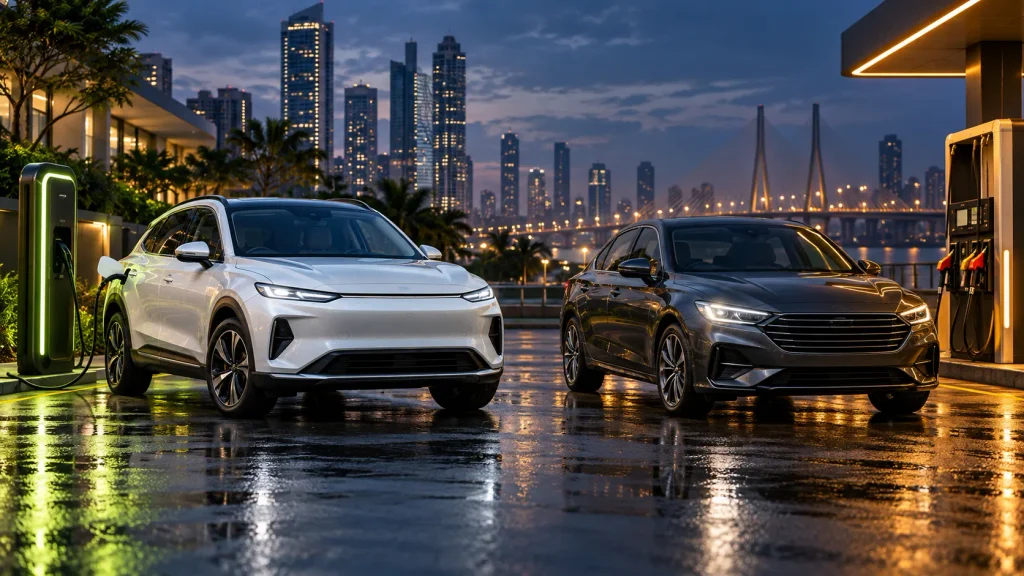
An electric car and a petrol car can look similar from the pavement. The difference becomes obvious once you drive them. An EV usually pulls away quietly and responds promptly to the accelerator. In a petrol car, you can hear the engine rev and may feel the gearbox change gears as speed rises.
That difference starts with how the wheels receive power. A petrol engine burns fuel to create movement. A battery-electric car takes energy from a battery and uses an electric motor to turn the wheels. Both designs can make a good everyday car, but they ask different things of their owners. If you are choosing your next vehicle in India, understanding the drivetrain helps you ask better questions about range, charging, running costs and service.
What is the difference between an EV motor and a petrol engine?
An electric motor converts electrical energy into rotation. A petrol engine burns a fuel-and-air mixture inside cylinders and turns the resulting motion into rotation. A battery EV therefore needs charging instead of petrol refills and has no tailpipe. A conventional petrol car needs fuel and produces exhaust while it runs. The design also changes how a car accelerates, slows down and is maintained. The US Department of Energy provides component-level explanations of battery-electric and gasoline cars.
| Buyer question | Battery-electric car | Petrol car |
|---|---|---|
| Where is energy stored? | In a rechargeable traction battery | In a fuel tank |
| What drives the wheels? | An electric motor through a reduction drive | An internal-combustion engine through a transmission |
| What do you replenish? | Electricity at home, work or a public charger | Petrol at a fuel station |
| What happens when slowing? | Regenerative braking may recover some energy; friction brakes still remain | Conventional friction braking mainly turns motion into heat |
| Does it have an exhaust pipe? | No tailpipe on a battery EV | Yes |
| What needs routine attention? | Tyres, brakes, fluids or filters where specified, battery and electrical-system checks | Those applicable items plus engine-related oil, filters and ignition components according to the service schedule |
The table describes battery-electric cars and conventional petrol cars. A hybrid has a different combination of engine, motor and battery, so check its particular design before applying the comparison.
How does a petrol engine move a car?
In a typical petrol car, a pump sends fuel from the tank to the engine. Air and fuel enter the cylinders, a spark plug ignites the mixture, and expanding gases push pistons. A crankshaft turns that movement into rotation. The transmission then helps deliver useful power to the wheels across different speeds. The engine also needs systems for cooling, lubrication and exhaust treatment.
This is a clever, mature technology, and drivers are familiar with its routine: fill the tank, start the engine and drive. A broad fuel-station network makes longer trips straightforward to plan. Petrol cars also vary enormously in efficiency, refinement and performance, so an engine label alone cannot tell you how a particular model will feel.
There are costs and tasks associated with that combustion process. The owner follows a service schedule that may include engine oil, filters and other engine-related parts. Fuel consumption changes with traffic, speed, load, air-conditioning and driving style. The amount printed in a brochure is a comparison figure; what you spend depends on your own use and the price you pay at the pump.
How does an electric motor move a car?
In a battery EV, electricity stored in the traction battery reaches the motor through power electronics. The motor turns the drivetrain and wheels. When you plug into an AC charger, the car’s onboard charger converts the incoming electricity so the battery can store it. A compatible DC fast charger performs conversion in the charging equipment before supplying DC power to the vehicle. The exact power accepted depends on both charger and car.
An EV also has supporting equipment. Its battery-management and thermal systems monitor operating conditions, while a smaller low-voltage system powers accessories. These components matter, but you do not need to memorise each one before shopping. What matters is knowing that battery capacity, motor output and charging capability describe different things. Battery size alone does not guarantee quick acceleration, long real-world range or rapid charging.
When comparing vehicles in the NUOVOS EV catalog, read the figures for the exact variant. Some models offer different battery packs or motor outputs under the same model name. If a number is missing or the listing and brochure disagree, ask the manufacturer or dealer to confirm it before relying on that figure.
Why does an EV feel quick from a stop?
Electric motors can deliver strong torque from low motor speeds. That often makes an EV feel responsive as soon as you press the accelerator, especially in town. A petrol engine typically develops its useful torque over a particular rev range, so its gearbox helps keep it working effectively as the car speeds up. The US Department of Energy notes the quick response electric motors can provide.
This does not mean every EV is faster than every petrol car. Vehicle mass, motor power, traction, software and gearing all affect acceleration. Some EVs are tuned for calm, efficient driving. Some petrol cars are genuinely quick. On a test drive, notice how smoothly the car pulls into traffic and overtakes at the speeds you actually use, rather than choosing from a single acceleration claim.
Does an electric car have gears?
Most mainstream battery EVs use a fixed reduction gear instead of the multi-speed gearbox drivers know from petrol cars. You still choose Drive, Reverse or Park, but there are usually no gear changes to manage while accelerating. A petrol car may have a manual or an automatic transmission with several ratios.
For many buyers, this makes an EV simple in stop-and-go traffic. The lack of gear changes can also make the drive feel smooth. It does not eliminate all drivetrain components, nor does it mean every EV uses the same design. Ask about the particular model if its operation matters to you.
What changes when you brake?
An EV motor can help slow the car while sending some energy back toward the battery. This is called regenerative braking. You may feel the car slow more noticeably when you lift your foot from the accelerator, depending on its settings. Some models let the driver choose a stronger or gentler level.
Regeneration does not recover every bit of energy you used to accelerate. Its effect varies with vehicle settings and conditions, and the car still needs its conventional friction brakes. The US Department of Energy explains that the motor can operate as a generator during slowing. On your test drive, try the available settings and see which feels natural in your traffic.
Is an EV motor more efficient than a petrol engine?
Electric drivetrains generally turn a larger share of energy stored in the vehicle into movement than petrol drivetrains. Combustion engines lose a substantial portion as heat. Regenerative braking can also recover part of the energy that would otherwise be lost during slowing. A US Department of Energy comparison illustrates this drivetrain-efficiency difference for a particular test cycle.
Do not turn that test result into a promise about your monthly bill or an unsupported environmental claim. Electricity generation, charging losses, local tariffs, petrol prices and how far you drive are separate questions. For a useful ownership comparison, enter your own mileage, energy use and prices in the NUOVOS Petrol vs EV calculator. Label any result as an estimate.
What about maintenance and repairs?
A battery EV has no engine oil to change and no exhaust system like a petrol car. Its electric powertrain generally has fewer routine engine-related service items. That does not make it maintenance-free. Tyres, brakes, suspension, cooling or cabin filters where specified, and other parts still need inspection. Regenerative braking may reduce wear on friction brakes, but those brakes must remain safe and functional. The US Department of Energy’s EV maintenance guide explains these differences.
A petrol owner should follow the maker’s engine and transmission service schedule. An EV owner should follow the maker’s battery, high-voltage system and general vehicle checks. Actual service prices vary by model, city, workshop and work required. Ask each dealer for the written schedule and an indicative quotation for your chosen variant. Check whether an authorised EV service centre is accessible from your home.
How do you pay for energy in everyday use?
With a petrol car, you buy litres of fuel. To estimate fuel cost per kilometre, divide the petrol price per litre by your car’s actual kilometres per litre. With an EV, you buy electricity measured in kilowatt-hours (kWh). To estimate its energy cost, combine electricity price per kWh with the car’s energy use per kilometre, allowing for charging losses.
These costs can be very different for a driver who charges mainly at home and one who depends on public fast charging. Your bill can also change when your tariff, mileage or driving conditions change. A lower estimated energy cost does not settle the full purchase decision: consider the vehicle price, financing, insurance, charger installation, service and eventual resale as well.
Use the Running Cost, Petrol vs EV and 5-Year Ownership calculators to test more than one scenario. Enter your real petrol and electricity prices. If you have no home charging, build a scenario around the public charging options you would actually use.
The practical difference in India: refilling versus charging
A petrol car’s familiar advantage is that you can refill relatively quickly at a fuel station. With an EV, your routine depends on where you park and charge. A buyer with dependable charging at home may wake up with enough energy for a normal day. A buyer relying on public stations needs to check connector compatibility, availability, payment and route coverage.
If you live in an apartment, do not assume charging installation is automatic. Speak to the building manager or society, assess your parking and electrical connection, and seek a qualified installation assessment. If you travel regularly between cities, examine the charging stops for your route and keep a backup option. The NUOVOS charging guide is a useful place to begin.
Neither routine suits everybody equally. Before choosing a drivetrain, write down your daily distance, longest regular trip and reliable charging location. You can then use the NUOVOS EV Finder to see which published EVs might meet your requirements.
How should a buyer decide between an EV and a petrol car?
Start with your use rather than a headline about technology. Ask yourself:
- Where will I replenish energy most weeks? Identify a realistic place to charge or the petrol stations on your routes.
- How far do I drive? Record normal days and the longest trip you make regularly.
- What is my full budget? Compare on-road prices for exact variants and financing terms, not just advertised starting prices.
- Who travels with me? Test rear-seat space, entry, boot capacity and comfort with your usual passengers.
- What does ownership cost under my conditions? Use your own mileage and energy prices, then include insurance, service and any charging setup.
- What support is nearby? Check the manufacturer’s service network, warranty wording and help available on longer journeys.
If two EVs make your shortlist, use NUOVOS Compare EVs to review available specifications side by side. The right choice is the one whose day-to-day routine, space and total cost make sense to you after the test drive and written quotes.
Frequently asked questions
Is an EV motor the same as a petrol engine?
No. An EV motor uses electrical energy to produce rotation. A petrol engine burns fuel and air inside cylinders to produce mechanical power. The two systems also differ in how they store energy, deliver power and are serviced.
Does an electric car need engine oil?
A battery EV does not have a petrol engine, so it does not need a petrol-engine oil change. It can still require other fluids, inspections and routine vehicle maintenance specified by its manufacturer.
Are all electric cars faster than petrol cars?
No. Many EVs feel responsive at low speed because their motors can provide torque promptly, but acceleration depends on the specific vehicle. Compare test-drive behaviour and verified specifications for the exact models.
Can regenerative braking fully stop an EV?
The behaviour depends on the model and setting. Some cars provide strong slowing, while others provide less. Regeneration does not replace the car’s friction braking system or safe brake use.
Is an EV always cheaper to run in India?
There is no universal result. Distance driven, home or public charging tariffs, petrol price, energy use and charging losses change the calculation. Purchase, finance, insurance and resale affect total ownership cost as well. Use the NUOVOS calculators with your own inputs.
Your next step
If the quiet response and charging routine of an EV appeal to you, browse electric cars in India, answer the EV Finder questions and compare your shortlist. Then test-drive the exact variants, check your charging plan and request written on-road quotes. That will tell you far more than the motor or engine label alone.
Sources used for technical review: US Department of Energy: How all-electric cars work; How gasoline cars work; EV maintenance; Electric vehicles and chargers. Check the current manufacturer brochure and warranty booklet before adding any model-specific figures.